

Have You Been Wondering…
Could I Be Autistic?
A Guided Exploration Built (Finally) for Women

COULD YOU BE AUTISTIC?…
You’ve Googled it. You’ve taken the quizzes. And now you’re really wondering…but you still don’t know.
I've heard so many versions of the same heartbreaking story. The woman who has always felt a little different from the other girls, always thought there must be something to make sense of it, to explain it — but no-one ever offered an explanation, or even noticed. So she pushed through, built a life, made it work. She may have even gathered a diagnosis or two along the way that at first seemed to be the explainer — anxiety, depression, maybe even ADHD — but again, they weren't.
But now… she's read the lists, seen the social media, maybe even done the questionnaires and interviews for her children — and something started to feel like it might fit. But how is she supposed to really know? The more she reads, the less sure she feels. What if she's reaching, jumping on the 'bandwagon'? What if she's wrong? She could look at assessment — but oh, the waits, the cost. And she's not even sure it'll be worth it.
AUTISTIC? MAYBE…
Does this sound like you?
You've always felt like the social stuff was so much harder than it looked — you flew under the radar, but it cost you
You've been told you're "too sensitive," "too blunt," or "too much" — but also somehow "too fine" to need help
You've pretended so well that even the people closest to you would be surprised you're wondering about this
You might have already been diagnosed with anxiety, depression, or ADHD — and treated — but something still feels unexplained
You look nothing like the autistic people you see represented in media, and you're not sure if that means you're not autistic, or just that the representation is wrong
You've done the online screeners and come away with more questions than answers
You're not ready to (or simply can’t) spend thousands on a formal assessment, but you can't keep sitting in the not-knowing

Here’s what I want you to know…the confusion you feel isn’t a sign that you’re wrong about yourself.
And the hesitation you feel about clarifying it, it makes sense.
Autism in women has been systematically under-researched, under-recognised, and under-diagnosed for decades.
The screeners, the checklists, the clinical criteria — most of it was built on data from men and boys. Women experience autism differently, present differently, and are missed differently.
So if you've searched for yourself in the information and come away uncertain — or if you just need help figuring out if you're on the right track — you need something designed with you in mind.
Imagine instead having a better understanding of yourself, of autism…and some answers!

Imagine…
Knowing which validated screeners to use — and how to approach them honestly (in the most useful way), especially if you're someone
who's spent a lifetime minimising your own experience.
Having your results interpreted for you through a female presentation lens, using the knowledge of a clinician that lives and breathes this, so the numbers actually
mean something.
And at the end of it, having a clearer sense of where you sit — not a diagnosis, but a genuinely informed
starting point. Something you can hold, refer back to, and take with you if and when you're ready for the
next step.
That’s what this Guided Exploration is.
OK, SO WHAT IS….
Could I Be Autistic?
A Guided Exploration Built (Finally) For Women
I hear from women every single day who are sitting with this question and have nowhere to take it yet.
They're on my waitlist — and probably several others — because the demand for clinicians who genuinely understand how autism presents in women far outstrips the supply. Or the cost of a formal assessment is real, and right now it's just not on the cards. Or they would love an assessment, but it's not their turn yet — there are children to get through the system first, or other priorities that can't wait. Or they're not even sure assessment is the right path yet, and they just need somewhere to start. Or honestly, some validation and a clearer picture is enough for right now.
This is a resource for all of those women.
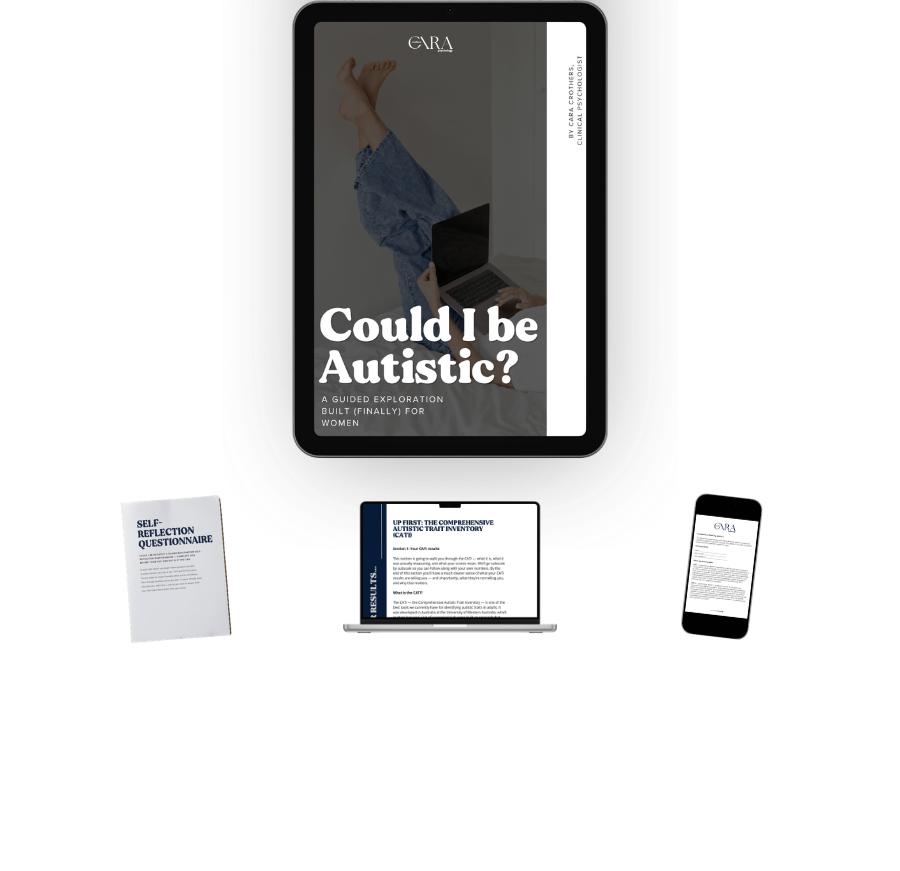
It's not a diagnosis. It's not a quiz that spits out a number and leaves you to figure out what it means. It's a guided process — built by a clinical psychologist with more than ten years experience working in autism — that walks you through the validated tools and helps you interpret what you find, through a lens that was actually designed with women in mind.

HERE’S WHAT YOU’LL RECEIVE…
Screeners. Knowledge.
…And a Guide to Interpret Your Results and Start Getting Answers
Guided Access to Two Validated Autism Screeners
The CATI and the CAT-Q — with clear instructions on how to approach them honestly, especially if you tend to minimise your own experience.
These are two of the tools I use in my own formal assessments. The CAT-Q captures masking (crucial for women) and the CATI reflects how autistic traits actually present in women far better than most.
A Guided Exploration of Your History
From childhood patterns to present-day experience, including the AuDHD overlap that so many women find themselves in. The questions are drawn from the kinds of things I hear from women in formal assessments — the patterns, the moments, and the memories. It's a small but rich way of looking at your experience beyond what the screeners alone can capture.
A Clinical Interpretation Guide through the Lens of Autistic WOMEN
Written through a female presentation lens, and shaped by my experiences working with and assessing autistic women, so you understand what your scores actually suggest, not just what the number is.
Because understanding how autism looks in women is part of being able to recognise it in yourself.
This resource is a self-guided educational tool, not a replacement for therapy or formal assessment. If you're currently struggling significantly with your mental health, I'd encourage you to speak with your doctor or a psychologist first - this will still be here when you're ready.

About Me…
I'm Cara Crothers, a clinical psychologist based in Australia. For the past ten years, my work has focused almost exclusively on autism — and in that time, the majority of the women I've assessed have come to me after years, sometimes decades, of not being seen clearly.
I built this resource because the "maybe" stage is real, it matters, and there was nothing out there designed to meet women in it. Nothing for the woman who is wondering, but not yet ready or able to pursue a formal assessment. The screeners I've directed you to are two of the validated tools used in clinical assessment (and in MY autism assessments). The interpretation guide reflects what I actually look for in practice. And the female presentation lens isn't a footnote — it's the whole point.
Clinical Psychologist, AHPRA - 10+ years in autism - 5 years exclusively with late-diagnosed autistic and AuDHD women.
You’ve been wondering. That wondering is worth taking seriously.
This is a way to start getting some answers.
FAQ
-
No. This resource cannot and does not provide a diagnosis — that requires a formal assessment with a qualified clinician. What it does is give you a structured, clinically-informed way to explore whether autism might be part of your experience, and a clearer sense of where to go from there.
-
Yes — deliberately. Most autism screening tools and much of the clinical literature were developed
using data from men and boys. This resource is built around female autistic presentation — which is still routinely missed in assessment. If you've looked at general autism content and not quite seen yourself in it, that might be why.
-
Yes. The screeners themselves (the CATI and CAT-Q) are freely available online, but a score without context isn't particularly useful — and for women, it can be actively misleading. This resource helps you approach the screeners properly and interpret what you find through a lens that actually accounts for how autism presents in women.
-
Yes — and this is more common than many people realise, particularly in women. Anxiety and depression are frequent co-occurring conditions in autistic women, and ADHD and autism co-occur a lot. If you've been treated for one of these and still feel like something is unexplained, that's worth exploring.
-
Due to the digital nature of this resource, I'm unable to offer refunds once purchase has been completed.
If you have any questions about whether this resource is right for you, please read through the full sales page carefully before purchasing.